Sunday, August 27, 2017

New science confirms: Earth was WARMER during Medieval period

A new technical paper that was published in GeoResJ shows that it is not possible to confirm that any recent warming of our planet is due to unnatural causes. After a team of scientists led by Jennifer Marohasy and Dr. John Abbot used big data techniques to assess six 2,000-year proxy temperature series, they discovered the recent warming on Earth might have happened even if there had never been an industrial revolution.
The most recent forecasts using artificial neural networks are believed to be more accurate than the general circulation models that have typically been used until now. The researchers fed data from various methods of measuring temperatures during the last 2,000 years, like coral cores and tree rings, into a machine learning neural network that predicted patterns of temperatures over the two millennia had there not been extra carbon dioxide from industrialization.
What the computer predicted was almost exactly what the temperatures around the world actually were during the time period under study. Indeed, the average divergence between their projection and the proxy temperature record was just 0.09 degree Celsius. This means that even without fossil fuels burning and the industrial revolution, warming would have still been noted on our planet through the 20th century.
After studying the six-proxy series from various geographic regions that have already been published in mainstream literature on climate science, they discovered lots of zigzags. However, there were two rising trends, one of which peaked around 1200 A.D. in the Medieval Warm Period and a second that peaked in 1980 before dropping off. The Little Ice Age occurred in the time between these peaks. During the earlier warming period, agriculture thrived in England. It was around this time that the Vikings settled Greenland and men donning tunics built great cathedrals.

Evidence piling up that Medieval period was hotter

The researchers’ evidence also shows that it was actually around one degree warmer throughout Europe during that time, confirming past studies. Some researchers have used remodeling in their favor to flatten the Medieval Warm Period and try to downplay its significance, but hundreds of scientists from 40 countries around the world have contributed peer-reviewed papers proving that the Medieval Warm Period was warmer than the present and this study is just the latest.
The findings of Marohasy and Abbot add to a growing mountain of evidence pointing to warmer temperatures during the past. According to a report from the Center for the Study of Carbon Dioxide and Global Change, the Medieval Warm Period was not only warmer than the current period, but it also lasted longer than the current warm period and was global in scope.
A comprehensive study out of Germany published in Nature Climate Change examined tree ring data and found that earlier estimates of historical temperatures during times like the Middle Ages and Roman Era were too low.
If the climate has been warmer in the past in the absence of any significant carbon dioxide emissions, it means that CO2 emissions do not have the huge impact on the climate that some parties with vested interests claim. It might be true that greenhouse gases can have a warming effect, but experts like respected climatologist Judith Curry believe that natural climate variability is playing a much stronger role in all this than human impact.
Sources include:
Spectator.com.au
Express.co.uk
ClimateDepot.com
TheRegister.co.uk

read more: http://www.naturalnews.com/2017-08-27-new-science-confirms-earth-was-warmer-during-medieval-period.html

Friday, August 25, 2017

Top 8 organic MISTAKES most people make because they have not done the research

There are no absolutes when it comes to a healthy lifestyle and clean eating. Many foods that were perfectly wholesome just months ago may be tainted and contaminated now if the farmer, company or corporation that makes them changed even just a few key ingredients, or worse yet, sold out to “Big Food.” Nothing is 100 percent reliable either. People jump on diet bandwagons and think some new fad is the “be all, end all” of diets and if they can just stick to it they’ve “got it made.” Wrong.
There are holes in every game, and exceptions to every rule. There are major problems with labels like “all natural” and “gluten free,” but we’ll save those topics for another article. If you thought going 80 percent or 90 percent or even 100 percent organic was “all good,” then you’ve got a bit more homework to do, but don’t worry, we’ve got your back. Let’s talk about organic mistakes millions of people are making and exactly why, so we can all stay on track with eating clean daily.

#1. Buying from organic companies that sold out to Big Food’s evil corporations

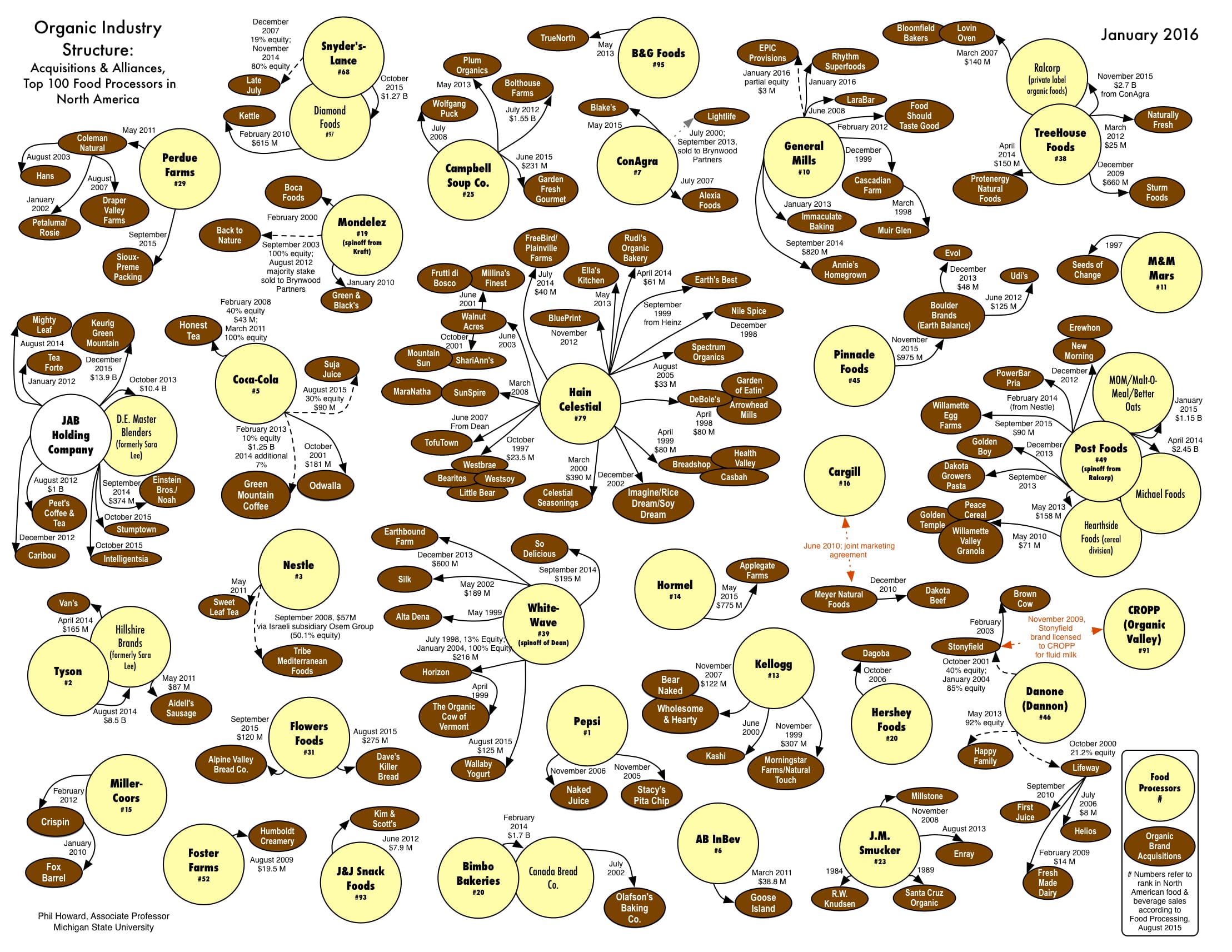
If you’re one of those smart shoppers who buys mainly organic, you better take a second look at “who” you’re buying, instead of just “what” you’re buying. Over the past few years, several smaller organic companies sold out to huge corporations so they could retire and enjoy the good life. Problem is that “good ole” company is now a bastard child of Big Food, and you can bet all the products that were once clean are now polluted with toxic foods, even though they’re still organic. Yes, it’s true. Big Food loves to push unfermented soy and rapeseed (canola) on us, and even when they’re organic they’re still bad for the body over the long term. Watch out for those high estrogen levels and that coagulating blood! Nothing good comes from it.
Here are some examples in case you aren’t up to date on the “who owns who” of the organic world of tainted food. Purdue Farms owns Hans. Coca Cola owns Suja juice, Green Mountain Coffee and Honest Tea. Not so “honest” anymore, huh? Campbell Soup Company owns Wolfgang Puck, Plum Organics and Bolthouse Farms. Nestle owns Sweet Leaf Tea and Tribe Mediterranean Foods. Pepsi owns Naked Juice and Stacy’s Pita Chips.
Wait, there are more. Hain Celestial owns Spectrum Organics, Garden of Eatin and Ella’s Kitchen, just to name a few. Kellogg owns Bare Naked, Kashi and Morningstar Farms. Did you know J.M. Smucker owns Santa Cruz Organic? You should also know that General Mills owns Muir Glen, Cascadian Farm, LaraBar and Annie’s Homegrown – the latter of which might not be so “homegrown” anymore.

#2. Buying organic foods that contain canola

Organic or not, canola oil is synthetic oil bred from its parent rapeseed. Big Food needed a cheap substitute for imported coconut oil and palm oil and bam! A creative Canadian scientist took the most toxic of all food-oil plants and reduced the toxicity to meet FDA “standards” (nothing to write home about). Canola oil is still toxic even when it contains zero pesticides, and that’s why it doesn’t matter if it carries the “certified organic” seal of approval from the USDA.
Studies of rats consuming canola revealed degeneration of the heart, kidneys, thyroid gland and adrenals. As soon as the scientists withdrew canola from the rats’ feed, the health damage rescinded. Don’t forget, humans are animals too, with 96 percent the same DNA as the rest of the animals on planet Earth, so don’t think this alarming canola research doesn’t apply to us. Canola oil is high in glycosides, which means it inhibits enzyme function and destroys the protective coating surrounding your nerves, and once that sheath is gone, you’re done for. Nerve damage sets in.
Canola oil, over the long term, can cause emphysema, constipation and respiratory distress. Don’t be fooled by the happy little term “expeller pressed.” It doesn’t matter because canola still carries the mutated rapeseed genes. Big Food still has to bleach it and deodorize it to remove the stink. Almost all organic mayonnaise products and organic salad dressings are loaded with canola or soy or both! Watch out.

#3. Buying organic foods that contain unfermented soy

Just since the year 2000, U.S. food manufacturers have introduced over 3,000 soy-based foods, many of which are labeled “certified organic,” but does that even matter? Any soy that is unfermented, whether organic or not, is linked to immune-system malfunctions, thyroid dysfunction and cognitive decline. In fact, no soy was fit to eat until the discovery of fermentation techniques during the Chou Dynasty. Anyone eating unfermented soy would suffer from eating anti-nutrient toxins that block the enzymes humans need for protein digestion, and that’s at just two tablespoons a day.
Hundreds of health studies reveal infant abnormalities, kidney stones and food allergies thanks to soy consumption. If you read or hear about the benefits of soy, they’re talking about fermented soy only. Most organic mayonnaise products and organic salad dressings are loaded with canola or soy or both! Watch out.

#4. Buying anything “certified organic” that was grown in China

With three times the population of America, China suffers major environmental pollution problems, including waste management, industrial and agricultural contamination, pharmaceutical contamination, plus inadequate water treatment. At least 70 percent of China’s water is so polluted it’s deemed unsafe for human contact. Some of the rivers there have such high metal content that they literally run red from rust. That means even if food is grown organically without pesticide use, it’s still contaminated across the board.

#5. Assuming that “USDA certified organic” means no heavy metal toxins

The USDA does not inspect certified organic food for heavy metal toxins at all. That would include lead, aluminum, mercury, nickel, copper, tungsten and arsenic. Can you believe it? You can have your levels tested by a Naturopathic Physician. Your best bet is to avoid all organic food that’s imported from China – the most polluted industrial nation in the world.

#6. Putting organic food in the microwave oven

The “nuker” not only destroys nutritive qualities of food within seconds, but produces wave energy radiation that interacts with food molecules, changing their polarity from positive to negative at millions of times per second. This severe agitation and friction bombards the food and forcefully deforms it. The scientific name for this is “structural isomerism.”

#7. Cooking organic meat on an outdoor grill

Even if meat is organic, when you grill it at high temperature and fat drips onto the heat source, potent carcinogens are created called polycyclic aromatic hydrocarbons (PAH’s). There is also a chemical reaction between the amino acids and creatine in the meat that forms dangerous heterocyclic amines (HCA’s). Lastly, you’re increasing the amount of advanced glycolytic enzymes (AGE’s) already present in the meat, causing inflammation and oxidative damage to tissues in your body.

#8. Boiling organic vegetables in water you got from the tap

You can’t boil out cancer-causing, IQ-lowering sodium fluoride from tap water. You need a high quality water filtration system like Big Berkey to do that. Don’t pollute your clean food with toxic tap water. Enough said.
Sources for this article include:
Cornucopia.org
NaturalNews.com
Koshland-Science-Museum.org
NaturalNews.com
FDA.news
News.BBC

read more: http://www.naturalnews.com/2017-08-23-top-8-organic-mistakes-most-people-make-because-they-have-not-done-the-research.html

Monday, April 10, 2017

Opium-like painkiller alternative can be found growing in your backyard

If you’re suffering from pain of any type, your first impulse might be to reach for a pill. If that is the case, then you are not alone. Many people rely on over-the-counter or prescription pain medication, but these come with the risk of severe side effects and drug dependency issues. A large segment of our population is popping these highly addictive meds like candy, often masking the problem rather than fixing it.
Did you know that many herbs and spices can treat inflammation and other related conditions that cause acute or chronic pain? Big Pharma, or the “legal drug lords” as Natural Blaze calls them, have most of us believing that if you want the “good stuff,” you need their drugs.
While they are laughing their way to the bank, millions of people are becoming addicted to these pills, which has led to the current epidemic of opioid addictions and overdoses. In the United States, it is so bad that prescription opioid-related deaths have surpassed gun-related deaths. Furthermore, once these people are caught in the web of a “legal” drug addiction, the step to the illegal market and heroin is easily made when they get turned away from the medical system.

Wild lettuce, a healthy morphine-like pain alternative growing in your backyard

Wild lettuce is a tall, leafy plant with small, yellow buds commonly found in gardens across North America and England. Also known as Lactuca Virosa, opium lettuce, or bitter lettuce, this medicinal plant has long been used in folk medicine as a substitute to opium, hence its name opium lettuce. While it has been used for centuries, it was in the 1970s that it started to gain significant popularity, both for pain relief and recreational purposes.
Opium lettuce’s pain-relieving and sedative effects come from the white substance, called lactucarium, found in the stem and leaves. Just like morphine, compounds in the milky substance act directly on the central nervous system to lessen the feeling of pain. Unlike its name may suggest, the plant doesn’t contain any opiates and is legal.
Patients with Epstein-Barr Virus, Fibromyalgia, nerve injury, surgical pain, and inflammation could all benefit from making the switch to this natural remedy. As reported by Ask A Prepper, next to its pain-relieving properties, this medicinal plant also works wonders in the treatment of coughs, insomnia, and anxiety. Migraine sufferers claim that they experience fewer migraine attacks when they use wild lettuce.
Furthermore, it can be very beneficial for asthma patients since opiate medications can cause more asthma episodes when they go through opiate withdrawal. The use of opium lettuce instead of opiate drugs could give the same results while keeping withdrawal symptoms and additional asthma attacks at bay.
There are many ways to consume the plant to reap its pain-relieving benefits. In the old days, people used to steep a herbal tea of the dried leaves and stems or cook the plant in water with a sugar mix until a syrup-like substance is left. While tea remains popular today, because of its bitter taste, many people are also using the dried leaves and stems for smoking or vaporizing. (RELATED: Learn more about natural remedies at Remedies.news.)
If you are not living in a place where this medicinal plant grows in the wild and are in pain, you shouldn’t miss out on its pain-relieving benefits. You can purchase wild lettuce as a dried herb, extract or resin. However, these commercial options may disappear in the near future. Given its euphoric qualities and recreational use, the U.S. Drug Enforcement Administration (DEA) is trying to add this natural, non-opiate plant to the list of illegal substances.
Sources:
NaturalBlaze.com
AskAPrepper.com
NaturalNews.com

Read more: http://www.naturalnews.com/2017-04-09-opium-like-painkiller-alternative-can-be-found-growing-in-your-backyard.html

Tuesday, March 28, 2017

Evidence EPA Colluded With Monsanto to Dismiss Cancer Concerns Grows Stronger

Saturday, March 18, 2017

Metabolically Supported Therapies for the Improvement of Cancer Treatment

Thursday, March 16, 2017

Glyphosate was patented as an antibiotic … is this contributing to antibiotic resistance?

For decades, the environment – rivers, lakes, fields, humans, livestock and wildlife – has been exposed to the toxic effects of glyphosate, the active ingredient in the weed killer Roundup. The chemical, classified as a probable carcinogen by the World Health Organization in 2015, has been linked to kidney disease, liver damage, birth defects, cancers, Parkinson’s disease, non-Hodgkin’s lymphoma and more.
Plus, as if this situation weren’t outrageous enough, troubling news is emerging about one of glyphosate’s less well-known properties. It turns out that glyphosate is also an antibiotic, and has been registered as such by the most hated corporation in the world, Monsanto.

Shocking new study about glyphosate reveals an alarming prospect

The very concept of resistant bacteria – in which mutating microorganisms become immune to the effects of antibiotics – is the stuff of nightmares, with resistant bacterial infections exacting a very real toll. According to the CDC, MRSA – or methicillin resistant staphylococcus aureus – claims over 11,000 lives a year.
Now, add glyphosate to the list of substances that can fuel antibiotic resistance in bacteria. In a study conducted at the University of Canterbury, New Zealand, researchers found that exposure to common herbicides – such as glyphosate and dicamba – caused bacteria to change their response to antibiotics, allowing them to display increased resistance.
The results were so surprising that the researchers feared some sort of error or contamination had affected their results. They enlisted a colleague at a different university to conduct the same experiments – and the findings were reproduced.

Glyphosate seems to “target” beneficial bacteria

And the harm from glyphosate doesn’t stop with its contribution to antibiotic resistance.
Glyphosate kills plants by interfering with a system called the shikamate pathway that regulates the synthesis of amino acids. As apologists for Monsanto never tire of pointing out, the shikamate pathway doesn’t exist in humans. But it does exist in bacteria – including the beneficial bacteria on which we depend for synthesis of amino acids.
Natural health experts have long insisted that glyphosate exposure can cause depletion of the amino acids tyrosine, tryptophan and phenylalanine – thereby setting the stage for obesity, autism and depression, as well as neurodegenerative conditions such as Parkinson’s and Alzheimer’s disease.
Researchers know from studies on chicken and cattle that ingestion of glyphosate can destroy beneficial bacteria in the digestive tract, while leaving dangerous bacterial pathogens – such as salmonella and E. coli – unharmed. There is no reason to believe glyphosate isn’t causing the same harm to humans – giving rise to the current epidemic of gastrointestinal conditions such as irritable bowel syndrome, inflammatory bowel disease and leaky gut.
In an article published in the scientific journal Entropy, the authors concluded that glyphosate could be the most important factor in the development of multiple chronic diseases that have become prevalent in Western societies.

Glyphosate’s toxic history is marked by skyrocketing use on food crops

Glyphosate, which has been in use since the 1970s, was initially only sprayed on weeds. But with the development of genetically engineered, glyphosate-tolerant “Roundup Ready” crops, the herbicide is now sprayed liberally on food crops – with glyphosate use doubling between 2001 and 2007 alone.
In a sickening chain of contamination, animals ingest glyphosate-laden feed, and humans then consume the meat – often along with produce that has been sprayed directly with Roundup. In this way, an unprescribed (and unsafe) drug succeeds in making its way from stockyards and fields to your plate, probably several times a day.

Monsanto’s glib reassurances are ridiculous

Monsanto continues to insist that glyphosate is not toxic to humans, which is laughable enough. But the company’s defense against concerns about glyphosate residue fueling antibiotic resistance take the word “ridiculous” to new levels. You can read it for yourself here.
Claiming that it is routine for companies to patent for “reasonable “ potential uses, Monsanto goes to considerable lengths to point out that glyphosate, “when used as recommended,” is not “concentrated” enough to function as a clinical antibiotic.
First, note the sanctimonious use of the disclaimer “when used as recommended.” As demonstrated by the heartbreaking accidental pesticide poisoning of four Texas children in January, chemicals are not always “used as recommended.” Human error, accident and mishap are an unfortunate reality.
Monsanto insists that the concentrations aren’t high enough to make glyphosate “clinically effective” as an antibiotic – but is clinical effectiveness even the point? Who knows at what concentration bacteria begin to develop resistance? Does anyone feel like gambling?
It’s worth nothing that a recent animal study showed that liver damage resulted from amounts of glyphosate that were many times lower than that allowed in tap water for human consumption. If damage can occur at those low levels, why not antibiotic resistance?

What you can do to reduce your exposure to glyphosate

The first step, of course, is avoiding the use of Roundup on your lawn and garden – and encouraging others to bypass it as well.  Say “no” to processed foods, “fast food” and junk food. Opt for grass-fed meat, pastured poultry, and certified organic products – which are guaranteed to be free of toxic pesticides and GMOs.
Glyphosate – a carcinogen, toxin, endocrine disruptor and DNA mutagen – has now been revealed as an antibiotic. And, the infuriating fact is: we’ve all been used like guinea pigs for this noxious chemical experiment.
References:
http://sustainablepulse.com/2015/03/24/new-study-shows-roundup-herbicide-causes-antibiotic-resistance-in-bacteria/#.WMUMkVXyvIV

Read more: http://www.naturalhealth365.com/glyphosate-roundup-2170.html