- Fluoroquinolones are antibiotics that contain fluoride, which allows them to penetrate into sensitive tissues like your brain and central nervous system
- Fluoroquinolone antibiotics are known to cause severe tendon damage and/or rupture, and permanent nerve damage in hands or feet
- Other side effects include acute liver toxicity, acute kidney failure, psychiatric side effects, hearing or vision problems, and other health problems—many of which are permanent
- Fluoroquinolones should be reserved for treating only the most serious bacterial infections that remain unresponsive to other treatments. Avoid them if at all possible
- Read more: http://articles.mercola.com/sites/articles/archive/2014/11/01/fluoroquinolone-antibiotic-side-effects.aspx?e_cid=20141101Z1_DNL_art_1&utm_source=dnl&utm_medium=email&utm_content=art1&utm_campaign=20141101Z1&et_cid=DM58891&et_rid=713897485
Saturday, November 1, 2014
The Dangerous Side Effects of Fluoridated Antibiotics

Thursday, October 30, 2014
CDC admits it has been lying all along about Ebola indirect contact transmission
Defying its own quack advice that the agency has been propagandizing for
months, the CDC has now released a document on Ebola that admits the
virus can spread through aerosolized droplets. The document, quietly
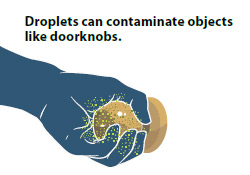
released on the CDC website, also admits Ebola can contaminate surfaces such as doorknobs, causing infections to be spread through indirect means. [1]
Here's a backup source of the PDF just in case the CDC scrubs it:
www.naturalnews.com/files/infections-spread-...
In other words, the CDC is now admitting it lied all along and that Natural News was correct from day one when we warned you about indirect transmission routes of the Ebola virus. (The CDC has always insisted it could only spread via "direct contact.")
"Ebola is spread through droplets," the CDC document now reads. Mirroring exactly what I've been telling millions of people in my free audio course at www.BioDefense.com the CDC now says "A person might also get infected by touching a surface or object that has germs on it and then touching their mouth or nose."
Yeah, we know. In fact, everybody in the independent media has known this for months, while all those who watch mainstream media sources are just now realizing this because they've been repeatedly lied to by CDC and NIH spokespeople.
The CDC has offered no apology whatsoever for intentionally misleading the public up to this point. Apparently, lying to the public is such a common activity at the highest levels of the CDC that they don't think there's anything wrong with it.
This also means the CDC's previous assertion that Ebola could only spread through "direct contact" is utterly false. It's just one more reason to never trust anything the CDC tells you. (The CDC has already lost tremendous credibility in all this, and it's going to lose even more before this is finished...)
Just this week, a stunning new scientific study found that Ebola can survive on contaminated surfaces for up to 50 days. This means an infected Ebola carrier like Dr. Spencer could have sneezed on a doorknob or other surface, causing viable Ebola droplets to be deposited there. Another person could have come along and touched the same doorknob, then infected themselves with Ebola by touching their own eyes, nose or mouth.
Dr. Spencer, we have now learned, lied to police and claimed he was "self quarantined" when in fact he was riding the subway and visiting restaurants and bowling alleys. As the NY Post reports: [3]
The city's first Ebola patient initially lied to authorities about his travels around the city following his return from treating disease victims in Africa, law-enforcement sources said. Dr. Craig Spencer at first told officials that he isolated himself in his Harlem apartment -- and didn't admit he rode the subways, dined out and went bowling until cops looked at his MetroCard the sources said.
In this document that admits Ebola can be spread via aerosolized droplets, the CDC falsely insists those droplets can only travel a maximum distance of 3 feet:
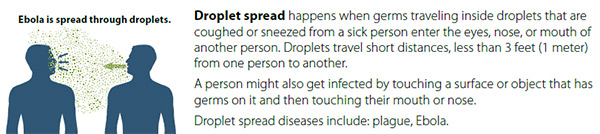
But a recent MIT study published in the Journal of Fluid Mechanics found that coughs could propel droplets up to 20 feet. [4]
 "When
you cough or sneeze, you see the droplets, or feel them if someone
sneezes on you," said John Bush, a professor of applied mathematics at
MIT and co-author of the study. "But you don't see the cloud, the
invisible gas phase. The influence of this gas cloud is to extend the
range of the individual droplets, particularly the small ones."
So now, even though the CDC has finally admitted Ebola can spread through the air, it is falsely claiming the maximum distance it can spread is only 3 feet.
By the way, the alternative media -- sources like www.TruthStreamMedia.com and www.TheCommonSenseShow.com -- have been reporting the truth about the aerosolized spread of Ebola for months.
In fact, Infowars.com originally got this completely wrong, reporting in August that "aerosol transmission is not possible" but then finally coming around once I corrected them about viral transmission via aerosolized particles in this article.
The mainstream media, as always, has dutifully repeated the lies of the CDC all along, parroting whatever medical quackery and anti-science nonsense Thomas Frieden and Anthony Fauci are pushing at the moment. What's especially hilarious in all this is how Frieden and Fauci, who are positioned by the lamestream media as the most authoritative and credible representatives of modern epidemiological science, have been caught lying over and over again about Ebola's transmission vectors. The loss of credibility the CDC has already experienced over Ebola is just staggering. Nobody believes anything the CDC says anymore, and rightly so.
If you want to learn the truth about Ebola, pandemic preparedness and medical isolation protocols, you have to get that information from independent sources such as www.BioDefense.com
The following infographic I created here at Natural News reveals just some of the quackery and fuzzy math pushed by the CDC over the last few months:

Sources for this article include:
[1] http://www.cdc.gov/vhf/ebola/pdf/infections-...
[2] http://www.naturalnews.com/047442_Ebola_aero...
[3] http://nypost.com/2014/10/29/ebola-doctor-li...
[4] http://www.naturalnews.com/047438_ebola_tran...
Here's a backup source of the PDF just in case the CDC scrubs it:
www.naturalnews.com/files/infections-spread-...
In other words, the CDC is now admitting it lied all along and that Natural News was correct from day one when we warned you about indirect transmission routes of the Ebola virus. (The CDC has always insisted it could only spread via "direct contact.")
"Ebola is spread through droplets," the CDC document now reads. Mirroring exactly what I've been telling millions of people in my free audio course at www.BioDefense.com the CDC now says "A person might also get infected by touching a surface or object that has germs on it and then touching their mouth or nose."
Yeah, we know. In fact, everybody in the independent media has known this for months, while all those who watch mainstream media sources are just now realizing this because they've been repeatedly lied to by CDC and NIH spokespeople.
The CDC has offered no apology whatsoever for intentionally misleading the public up to this point. Apparently, lying to the public is such a common activity at the highest levels of the CDC that they don't think there's anything wrong with it.
CDC also admits Ebola can contaminate surfaces and spread through indirect contact
"Droplets can contaminate objects like doorknobs," the CDC document goes on to admit. This also means that Ebola can contaminate all sorts of surfaces, including ATM keypads, subway car hand rails, airplane tray tables, taxicab door handles and much more.This also means the CDC's previous assertion that Ebola could only spread through "direct contact" is utterly false. It's just one more reason to never trust anything the CDC tells you. (The CDC has already lost tremendous credibility in all this, and it's going to lose even more before this is finished...)
Just this week, a stunning new scientific study found that Ebola can survive on contaminated surfaces for up to 50 days. This means an infected Ebola carrier like Dr. Spencer could have sneezed on a doorknob or other surface, causing viable Ebola droplets to be deposited there. Another person could have come along and touched the same doorknob, then infected themselves with Ebola by touching their own eyes, nose or mouth.
Dr. Spencer, we have now learned, lied to police and claimed he was "self quarantined" when in fact he was riding the subway and visiting restaurants and bowling alleys. As the NY Post reports: [3]
The city's first Ebola patient initially lied to authorities about his travels around the city following his return from treating disease victims in Africa, law-enforcement sources said. Dr. Craig Spencer at first told officials that he isolated himself in his Harlem apartment -- and didn't admit he rode the subways, dined out and went bowling until cops looked at his MetroCard the sources said.
CDC still lying about how far a sneeze spreads
The art of lying is so instilled in the culture of the CDC that even when it reveals one stunning truth, it feels compelled to spread another lie at the same time.In this document that admits Ebola can be spread via aerosolized droplets, the CDC falsely insists those droplets can only travel a maximum distance of 3 feet:
But a recent MIT study published in the Journal of Fluid Mechanics found that coughs could propel droplets up to 20 feet. [4]
"When
you cough or sneeze, you see the droplets, or feel them if someone
sneezes on you," said John Bush, a professor of applied mathematics at
MIT and co-author of the study. "But you don't see the cloud, the
invisible gas phase. The influence of this gas cloud is to extend the
range of the individual droplets, particularly the small ones."So now, even though the CDC has finally admitted Ebola can spread through the air, it is falsely claiming the maximum distance it can spread is only 3 feet.
By the way, the alternative media -- sources like www.TruthStreamMedia.com and www.TheCommonSenseShow.com -- have been reporting the truth about the aerosolized spread of Ebola for months.
In fact, Infowars.com originally got this completely wrong, reporting in August that "aerosol transmission is not possible" but then finally coming around once I corrected them about viral transmission via aerosolized particles in this article.
The mainstream media, as always, has dutifully repeated the lies of the CDC all along, parroting whatever medical quackery and anti-science nonsense Thomas Frieden and Anthony Fauci are pushing at the moment. What's especially hilarious in all this is how Frieden and Fauci, who are positioned by the lamestream media as the most authoritative and credible representatives of modern epidemiological science, have been caught lying over and over again about Ebola's transmission vectors. The loss of credibility the CDC has already experienced over Ebola is just staggering. Nobody believes anything the CDC says anymore, and rightly so.
If you want to learn the truth about Ebola, pandemic preparedness and medical isolation protocols, you have to get that information from independent sources such as www.BioDefense.com
The following infographic I created here at Natural News reveals just some of the quackery and fuzzy math pushed by the CDC over the last few months:
Sources for this article include:
[1] http://www.cdc.gov/vhf/ebola/pdf/infections-...
[2] http://www.naturalnews.com/047442_Ebola_aero...
[3] http://nypost.com/2014/10/29/ebola-doctor-li...
[4] http://www.naturalnews.com/047438_ebola_tran...
Wednesday, October 29, 2014
AP IMPACT: If Ebola batters US, we are not ready
The U.S. health care apparatus is so unprepared and short on resources
to deal with the deadly Ebola virus that even small clusters of cases
could overwhelm parts of the system, according to an Associated Press
review of readiness at hospitals and other components of the emergency
medical network.
Experts broadly agree that a widespread outbreak across the country is extremely unlikely, but they also concur that it is impossible to predict with certainty, since previous Ebola epidemics have been confined to remote areas of Africa. And Ebola is not the only possible danger that causes concern; experts say other deadly infectious diseases — ranging from airborne viruses such as SARS, to an unforeseen new strain of the flu, to more exotic plagues like Lassa fever — could crash the health care system.
Continue: http://news.yahoo.com/ap-impact-ebola-readiness-lacking-many-ways-160115821.html
Ebola survives on surfaces for up to 50 days
Little-known research published in the Journal of Applied Microbiology
back in 2010 is upsetting the official story regarding Ebola, which
government officials claim cannot be spread through contaminated
surfaces. Scientists from the Biomedical Sciences Department at the
Defense Science and Technology Laboratory in the UK found that, contrary
to mainstream claims, Ebola can survive for up to 50 days on dried
surfaces, specifically on cold glass.
In order to better understand how filoviruses are transmitted, the team tested several strains of Ebola, including the ZEBOV (Zaire ebolavirus) species currently believed to be in circulation, to see how they survived under various conditions. Both the ZEBOV and MARV (Lake Victoria marburgvirus) strains were tested for survival rates in liquid suspensions and on plastic, glass and metal surfaces for multiple established time periods, as well as in dynamic aerosols (airborne).
According to the Daily Mail Online, both the ZEBOV and MARV strains were tested on glass, metal and plastic at 4 degrees Celsius (39 degrees Fahrenheit) or room temperature for several weeks. Plotted charts contained in the study show the survival rates of the viruses in the different media. While both viruses were found to survive for 26 days on the cold plastic, ZEBOV survived for nearly two months, or 50 days, on the chilled glass.
At no point in the study were scientists able to obtain a sample of either virus from the metal substrate, made from stainless steel.
"This study has demonstrated that filoviruses are able to survive and remain infectious for cell culture, for extended periods when suspended within liquid media and dried onto surfaces," wrote the researchers about their findings. "Data from this study extend the knowledge on the survival of filoviruses under different conditions and provide a basis with which to inform risk assessments and manage exposure."
The study is available for free here:
OnlineLibrary.Wiley.com [PDF].
The U.S. Centers for Disease Control and Prevention (CDC), along with the Obama White House, continues to claim that Ebola is not spread through air, water or food, and that it only transmits from an infected person through direct contact with his or her bodily fluids. But this study of Ebola survival on surfaces suggests that these reassurances by the government are false.
Besides its surface transmission potential, Ebola can also travel through the air via aerosol particulates, such as those expelled when a person coughs or sneezes. This was confirmed in a recent Massachusetts Institute of Technology (MIT) study which found that Ebola-contaminated micro-droplets can travel as far as 20 feet from an infected person, potentially distributing throughout a hospital's ventilation system, for instance.
"[C]oughs and sneezes have associated gas clouds that keep their potentially infectious droplets aloft over much greater distances than previously realized," explains the MIT study, the announcement for which is available through MIT News:
NewsOffice.MIT.edu.
"[T]he smaller droplets that emerge in a cough or sneeze may travel five to 200 times further than they would if those droplets simply moved as groups of unconnected particles -- which is what previous estimates had assumed. The tendency of these droplets to stay airborne, resuspended by gas clouds, means that ventilation systems may be more prone to transmitting potentially infectious particles than had been suspected."
Learn all these details and more at the FREE online Pandemic Preparedness course at www.BioDefense.com
Sources:
http://onlinelibrary.wiley.com [PDF]
http://www.dailymail.co.uk
http://www.washingtonsblog.com
http://newsoffice.mit.edu
http://www.intellihub.com
http://science.naturalnews.com
In order to better understand how filoviruses are transmitted, the team tested several strains of Ebola, including the ZEBOV (Zaire ebolavirus) species currently believed to be in circulation, to see how they survived under various conditions. Both the ZEBOV and MARV (Lake Victoria marburgvirus) strains were tested for survival rates in liquid suspensions and on plastic, glass and metal surfaces for multiple established time periods, as well as in dynamic aerosols (airborne).
According to the Daily Mail Online, both the ZEBOV and MARV strains were tested on glass, metal and plastic at 4 degrees Celsius (39 degrees Fahrenheit) or room temperature for several weeks. Plotted charts contained in the study show the survival rates of the viruses in the different media. While both viruses were found to survive for 26 days on the cold plastic, ZEBOV survived for nearly two months, or 50 days, on the chilled glass.
At no point in the study were scientists able to obtain a sample of either virus from the metal substrate, made from stainless steel.
"This study has demonstrated that filoviruses are able to survive and remain infectious for cell culture, for extended periods when suspended within liquid media and dried onto surfaces," wrote the researchers about their findings. "Data from this study extend the knowledge on the survival of filoviruses under different conditions and provide a basis with which to inform risk assessments and manage exposure."
The study is available for free here:
OnlineLibrary.Wiley.com [PDF].
Government lies again: Ebola can be transmitted by touching contaminated surfaces
Though real-world conditions vary from those in a laboratory, these findings suggest that, once again, the U.S. government has lied to the public about the dangers of Ebola. If it is really true that Ebola can survive on dry surfaces where it would be impossible for the virus to incubate, then the risk of disease transmission is much higher than we are all being told.The U.S. Centers for Disease Control and Prevention (CDC), along with the Obama White House, continues to claim that Ebola is not spread through air, water or food, and that it only transmits from an infected person through direct contact with his or her bodily fluids. But this study of Ebola survival on surfaces suggests that these reassurances by the government are false.
Besides its surface transmission potential, Ebola can also travel through the air via aerosol particulates, such as those expelled when a person coughs or sneezes. This was confirmed in a recent Massachusetts Institute of Technology (MIT) study which found that Ebola-contaminated micro-droplets can travel as far as 20 feet from an infected person, potentially distributing throughout a hospital's ventilation system, for instance.
"[C]oughs and sneezes have associated gas clouds that keep their potentially infectious droplets aloft over much greater distances than previously realized," explains the MIT study, the announcement for which is available through MIT News:
NewsOffice.MIT.edu.
"[T]he smaller droplets that emerge in a cough or sneeze may travel five to 200 times further than they would if those droplets simply moved as groups of unconnected particles -- which is what previous estimates had assumed. The tendency of these droplets to stay airborne, resuspended by gas clouds, means that ventilation systems may be more prone to transmitting potentially infectious particles than had been suspected."
Learn all these details and more at the FREE online Pandemic Preparedness course at www.BioDefense.com
Sources:
http://onlinelibrary.wiley.com [PDF]
http://www.dailymail.co.uk
http://www.washingtonsblog.com
http://newsoffice.mit.edu
http://www.intellihub.com
http://science.naturalnews.com
U.S. State Dept. to transport foreign Ebola victims to U.S. hospitals for treatment
First we were told that Ebola wouldn't come to America. Then we were
promised the best way to keep Ebola out of America was to eliminate
quarantines and travel restrictions. Now, to the astonishment of nearly
everyone, the U.S. government is planning to deliberately transport
Ebola-infected foreigners to the United States for treatment in U.S.
hospitals. Taxpayers will foot the bill, estimated at half a million
dollars per patient.
This has all come out in a four-page memo acquired by the Washington Times. "The State Department has quietly made plans to bring Ebola-infected doctors and medical aides to the U.S. for treatment," the Times reports. [1] " The memo even details the expected price per patient, with transportation costs at $200,000 and treatment at $300,000."
The U.S. State Dept. is the same government entity that recently posted an acquisition contract for 160,000 Ebola hazmat suits, which many now believe are being stockpiled in the United States to deal with the Ebola outbreak that's widely anticipated by the government.
So far in the battle against Ebola, the U.S. federal government and White House seem to be working in favor of the deadly virus instead of against it. At every turn, the CDC has deliberately misinformed the public about the ease of Ebola transmission, lied about its incubation period, lied about the spread distance of aerosolized body fluids, prevented the implementation of travel restrictions and even actively dismantled quarantine policies in New Jersey and New York.
Remember: This is an administration that went from saying Ebola won't ever come to America to literally importing Ebola-infected patients into U.S. hospitals under a deliberate plan to bring them here!
Each day that I read the news on Ebola, I am increasingly astonished at the almost unimaginable reluctance of the Obama administration to support anything that might protect Americans from the pandemic. Every good idea that might offer hope for keeping America safe -- such as the NJ and NY mandatory quarantines for high-risk travelers -- has been immediately and deliberately shot down by the White House working in unison with the CDC.
The ludicrousness of government actions on all this has me wondering whether the CDC should change its name to the Centers for Disease Collaboration.
Above all, given that U.S. hospitals have already proven they cannot contain Ebola in patients, how does the State Dept. think that bringing more Ebola patients to the United States is supposed to protect Americans?
Ebola may not have yet spread across America, but mental insanity is already an epidemic in Washington D.C.
Sources for this article include:
[1] http://www.washingtontimes.com/news/2014/oct...
[2] http://video.foxnews.com/v/3863644702001/non...
This has all come out in a four-page memo acquired by the Washington Times. "The State Department has quietly made plans to bring Ebola-infected doctors and medical aides to the U.S. for treatment," the Times reports. [1] " The memo even details the expected price per patient, with transportation costs at $200,000 and treatment at $300,000."
The U.S. State Dept. is the same government entity that recently posted an acquisition contract for 160,000 Ebola hazmat suits, which many now believe are being stockpiled in the United States to deal with the Ebola outbreak that's widely anticipated by the government.
So far in the battle against Ebola, the U.S. federal government and White House seem to be working in favor of the deadly virus instead of against it. At every turn, the CDC has deliberately misinformed the public about the ease of Ebola transmission, lied about its incubation period, lied about the spread distance of aerosolized body fluids, prevented the implementation of travel restrictions and even actively dismantled quarantine policies in New Jersey and New York.
America now governed by the Ebola administration
It is difficult to imagine how the U.S. government could be more of an ally of Ebola than it is already. It has done everything imaginable to promote the spread of Ebola short of lining people up and injecting them with it.Remember: This is an administration that went from saying Ebola won't ever come to America to literally importing Ebola-infected patients into U.S. hospitals under a deliberate plan to bring them here!
Each day that I read the news on Ebola, I am increasingly astonished at the almost unimaginable reluctance of the Obama administration to support anything that might protect Americans from the pandemic. Every good idea that might offer hope for keeping America safe -- such as the NJ and NY mandatory quarantines for high-risk travelers -- has been immediately and deliberately shot down by the White House working in unison with the CDC.
The ludicrousness of government actions on all this has me wondering whether the CDC should change its name to the Centers for Disease Collaboration.
Above all, given that U.S. hospitals have already proven they cannot contain Ebola in patients, how does the State Dept. think that bringing more Ebola patients to the United States is supposed to protect Americans?
Ebola may not have yet spread across America, but mental insanity is already an epidemic in Washington D.C.
Sources for this article include:
[1] http://www.washingtontimes.com/news/2014/oct...
[2] http://video.foxnews.com/v/3863644702001/non...
Candy Swaps To Avoid Toxic Chemicals on Halloween
Before I knew anything about food and its effects on the body – I was
a candy addict. To my family and friends, I was the queen of candy! I
knew every brand, every flavor, and always had candy with me. And then,
during my wellness journey years ago, when I discovered all my beloved
candy had chemicals, trans fats, preservatives and petroleum based
artificial colors added to it – I flipped. I immediately banned all
major brands of candy and haven’t looked back.
Just look at the ingredients in Starbursts & Twizzler Twerpz and you’ll see what I mean.

 I also found out these brands contain GMOs (genetically modified organisms) – something I hadn’t given much thought to until recently.
And then I thought about the upcoming holiday and how many people are going to be buying this junk and giving genetically modified candy to their friends, neighbors and families.
If you’ve already bought your Halloween candy and it’s one of these brands on the left of this chart below – you might want to start looking for your receipt.
I created this chart to help navigate better candy choices without the added chemicals, preservatives, trans fats, artificial colors and GMOs. The brands on the right are amazing GMO free substitutes that are very similar tasting to the popular candy brands on the left.
 Many of the better and GMO free candy options are available to
purchase at local health food stores, on the internet and at even some
mainstream stores like Target.
Tell all your friends, neighbors and family members you want a GMO free Halloween this year and share these ideas with them.
XOXO,
Food Babe
P.S. Don’t forget to read my full investigation on chocolate and my other favorite chocolate brands here.
P.P.S. If you’d like to keep your Halloween completely candy free and GMOfree – Check out these adorable jack-o-latern faced tangerines a fan posted on my Facebook page and 100 Days of Real Food’s 20 ways to do Halloween without candy.

Source: http://foodbabe.com/2012/10/10/does-your-favorite-candy-have-gmos/
Just look at the ingredients in Starbursts & Twizzler Twerpz and you’ll see what I mean.
I also found out these brands contain GMOs (genetically modified organisms) – something I hadn’t given much thought to until recently.And then I thought about the upcoming holiday and how many people are going to be buying this junk and giving genetically modified candy to their friends, neighbors and families.
If you’ve already bought your Halloween candy and it’s one of these brands on the left of this chart below – you might want to start looking for your receipt.
I created this chart to help navigate better candy choices without the added chemicals, preservatives, trans fats, artificial colors and GMOs. The brands on the right are amazing GMO free substitutes that are very similar tasting to the popular candy brands on the left.
Many of the better and GMO free candy options are available to
purchase at local health food stores, on the internet and at even some
mainstream stores like Target.- Endangered Species Organic Chocolate
- UnReal Candy #54 and UnReal Candy #41
- UnReal #8
- Panda Raspberry or Cherry Licorice
- Annie’s Organic Bunny Fruit Snacks - (FYI – Annie’s was bought by General Mills, Lovely Candy Company is another great alternative that tastes like Starbursts)
- Yummy Earth Organic Gummy Bears
- UnReal #77 Peanut Butter Cups
- Surf Sweets Sour Berry Bears
- Yummy Earth Organic Candy
Tell all your friends, neighbors and family members you want a GMO free Halloween this year and share these ideas with them.
XOXO,
Food Babe
P.S. Don’t forget to read my full investigation on chocolate and my other favorite chocolate brands here.
P.P.S. If you’d like to keep your Halloween completely candy free and GMOfree – Check out these adorable jack-o-latern faced tangerines a fan posted on my Facebook page and 100 Days of Real Food’s 20 ways to do Halloween without candy.
Source: http://foodbabe.com/2012/10/10/does-your-favorite-candy-have-gmos/
Tuesday, October 28, 2014
Top Official Contradicts Obama; You Can Catch Ebola From Bus Sweat
Department of Health and Human Services Assistant Secretary Dr. Nicole
Lurie contradicted President Barack Obama’s claim that the Ebola virus
couldn’t be contracted by sitting next to an Ebola victim on a bus
during testimony in front of the House Oversight and Government Reform
Committee.
During questioning by Republican Kentucky Rep. Thomas
Massie, Lurie acknowledged that the Ebola virus “can survive” on inert
surfaces and that methods of transmission “include perspiration.”
International Medical Corps. official Rabih Torbay also
said that transmission via close proximity on a bus “could be possible”
through perspiration, while Marine Corps Major General James Lariviere
remarked that the virus, “can be transmitted through sweat.”
Lurie’s remarks contradict advice given by President Barack Obama earlier this month when he told residents of West African countries, “You cannot get it through casual contact like sitting next to someone on a bus.”
Obama repeated the claim
during an October 18 video message to Americans when he stated, “You
cannot get it [Ebola] from just riding on a plane or a bus.” The
President made the remarks one day after a bus that had departed from
the Pentagon was quarantined after a passenger became sick.
The Centers for Disease Control’s official guidelines for anyone who may have been exposed to the Ebola virus include, “avoiding public transportation” and all other travel.
Meanwhile, Congressman Peter King caused controversy when he questioned the notion, repeatedly asserted by the likes of the CDC, that the Ebola virus had not gone airborne.
“You know my attitude was, it’s important not to
create a panic and it’s important not to overreact and the doctors were
absolutely certain that this cannot be transmitted and it was not
airborne, and yet we find out the people who have contracted it were
wearing all protective gear,” said King, adding that he would be
concerned about being in close proximity to a potential victim in a
supermarket or a dentist’s office.
Facebook @ https://www.facebook.com/paul.j.watson.71
FOLLOW Paul Joseph Watson @ https://twitter.com/PrisonPlanet
FOLLOW Paul Joseph Watson @ https://twitter.com/PrisonPlanet
Subscribe to:
Posts (Atom)